
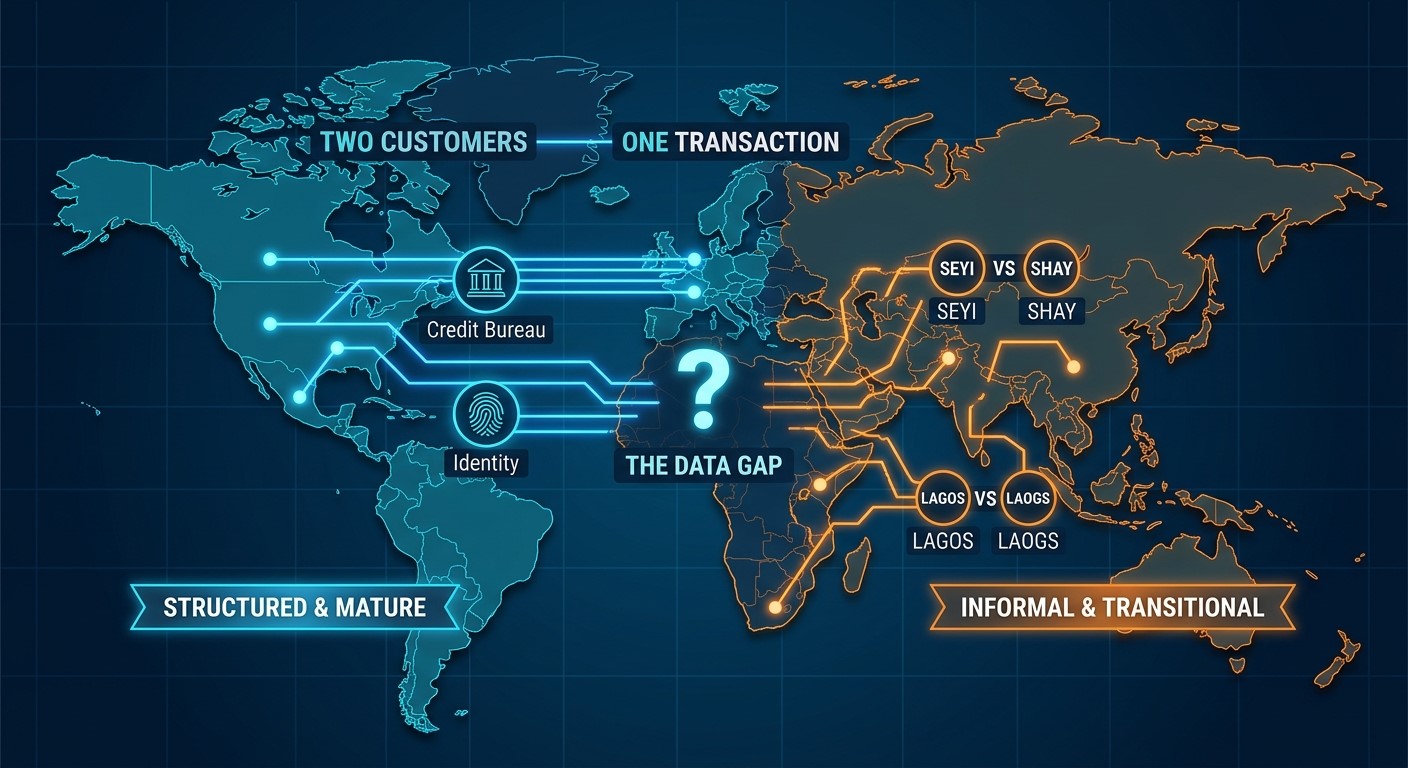

Every cross-border payment has two customers. There’s the sender, who lives in a market with mature identity infrastructure (credit bureaux, open banking, structured addresses) and a bank that already knows exactly who they are. And there’s the beneficiary, who often lives in a market where identity is informal, addresses aren’t standardised, and the name on the account may be transliterated three different ways across three different systems.
Photo Credit: Google Gemini AI
Most financial institutions built their data quality and compliance stacks for one side of that equation. They were designed for customers who live in a single regulatory perimeter. But the fastest-growing financial institutions in the UK and EU now serve customers whose data lives in five. Nobody owns the gap in between, and it’s expensive.
We wanted to know whether that’s a real, current, evidenced problem, or just a good story. So we went looking for the receipts. Here’s what we found.
The four places the cost lands
Failed payouts
In March 2024, Nigeria’s central bank enforced a rule blocking debit and credit activity on any bank account or mobile wallet not linked to a verified Bank Verification Number (BVN) or National Identification Number (NIN). At the time, reporting put as many as 85.5 million accounts at risk of being locked out. This is a striking illustration of what happens at national scale when identity data doesn’t match cleanly. Separately, an analysis of roughly 12,000 Nigerian payment-support tickets found that 42% of users had made at least one irreversible transfer mistake in the past year. Wrong-account payments aren’t an edge case. They’re routine.
False-positive sanctions screening
Ask anyone who’s worked in remittance compliance and they’ll tell you name screening is the number one source of friction. The data backs them up: name-matching systems that don’t handle transliteration properly can produce false-positive ratesover 90% on cross-border payments. One sanctioned individual can appear under a dozen valid spellings once you account for how Arabic, Chinese or Cyrillic names get rendered in Latin script, and every spelling variant can trigger a fresh, wrongly flagged alert. It’s not surprising that OFAC penalties against fintechs reportedly jumped from roughly $49 million in 2024 to over $265 million in 2025.
Multi-regulator reporting
In September 2025, the Bank of Ghana suspended the remittance partnerships of five money transfer operators (Taptap Send, Top Connect, Remit Choice, Send App and Afriex) in one action, for running remittance activity through payment providers and a settlement bank without the required regulatory approval. Five recognised brands, one jurisdiction, one month, shut down simultaneously. That’s what “parallel compliance stacks” actually costs when it goes wrong. It’s also expensive to get right in the first place: achieving US money-transmitter coverage across all 50 states can run $3-7 million and take up to two years; a single new remittance corridor typically costs €800k–€1.5M to launch compliantly.
Thin-file credit
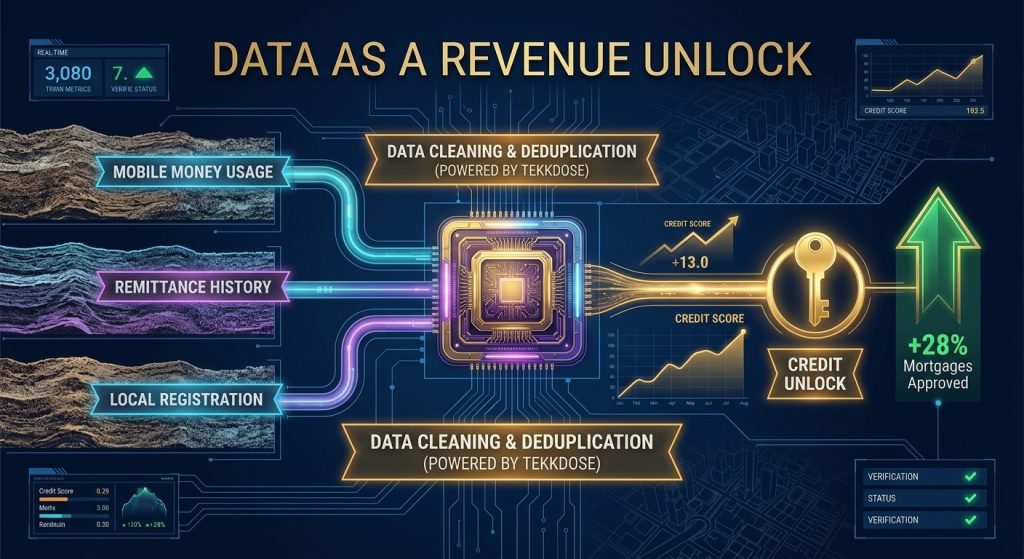
Photo Credit: Google Gemini
Here’s the flip side. Clean identity data isn’t just a compliance cost, it’s a revenue unlock. In Ghana, Letshego’s “Qwikloan” product scores mobile-money transaction history to make instant credit decisions and has served over 1.2 million customers. Bloom Impact combines mobile-money data with business-registration records to score micro-entrepreneurs, reporting 31% better repayment prediction than traditional methods. Ghana Home Loans factors diaspora remittance consistency directly into mortgage underwriting, and reports a 28% lift in approval rates for middle-income applicants. Remittance behaviour only becomes usable credit data once identity is clean, deduplicated and verified, and that’s already a live commercial thesis, not a hypothesis
Why this is happening now, not eventually
Three forcing functions are converging at once.
- London has become a genuine anchor point for diaspora finance. In April 2026, LemFi (one of the sector’s fastest-growing platforms) announced a £100 million, five-year investment and named London its new global headquarters, during a UK State Visit from Nigeria’s president HE Bola Ahmed Tinubu. Also, LemFi’s own recent moves (acquiring UK credit fintech Pillar in 2025 to serve “credit-invisible” customers, securing EEA market access via Ireland), and further acquisition of Wealth8 – and inclusive investment platform – depend on exactly the kind of clean, cross-border identity data this problem is about.
- Regulatory fragmentation is measurably slowing the industry down. GSMA’s 2025 data shows 24% of mobile money providers say cross-border data-transfer regulation has actively hindered their operations. This is not a future risk, it’s a current one.
- ISO 20022 is putting a hard deadline on it. From 14 November 2026, Swift will fully decommission unstructured address data from cross-border payment messages. Any payment carrying a non-conforming address gets rejected outright. For institutions processing thousands of cross-border payments a day, that’s not a formatting inconvenience but a straight-through-processing cliff edge.
What we’re doing about it
At Tekkdose, we’re building a verified-data layer for cross-border finance, with a platform already proven in financial services (Shawbrook Bank uses it for financial-crime reporting; St. James’s Place, which manages over £184 billion in client funds, uses it to unify data quality across its reporting). What’s new is applying that proven engine to corridor-specific problems: BVN/NIN validation in Nigeria, mobile-money API adapters in East Africa, account-name verification in India and Pakistan. It is exposed as point-of-capture APIs inside onboarding and transfer flows, with data residency by design, so only verification outcomes cross borders, never raw personal data.
We’re starting with a fixed-scope, four-week audit of a single corridor – UK to Nigeria – using our Business Impact Analysis tool to put a real number on what dirty beneficiary data is costing in failed payouts, screening delays and manual review, then a costed roadmap to fix it at the point of capture.
If beneficiary data quality is costing your institution money in failed payouts, false-positive holds, or a regulator asking questions you can’t answer quickly, we’d like 45 minutes to test this thinking against your reality.